Showing posts with label Tharparkar. Show all posts

Friday, March 18, 2011

Discovery of artisan well ushers in new era in Tharparkar


By Saleem Shaikh, Dawn.com

March 17, 2011

Fifty-year-old herdsman Mohammad Siddiqui resides in bordering village of Somosama near Khokhrapar north of Umerkot town of Tharparkar district. Every morning he used to move around along with his cattle in the area in search of water for them, some times as far as 20 kilometres. It was very rare that he would find sweet and fresh water in the area.

“Because of protracted drought spells with scarce rainfalls in the district, water level in most of the dug wells of his village, like any another villages, has decreased as much as 700-800 feet, which is usually brought out by means of pulley for domestic purposes,” Mohammad Siddiqui narrated.

But discovery of the weird ‘artisan well’ in Somosama villager, which gushes out an average of 3,84,000 gallons of water daily without any external pumping machine, has cheered up many aggrieved locals like Mohammd Siddiqui.

During a recent visit to the area, this scribe witnessed expressions of delight on faces of the locals and cattle breeders, who were seen huddling their cattle herds now in large multitudes towards the artisan well site from nearby and far-off villages for water.

Some herdsmen say that they bring their cattle daily to the artisan well from faraway villages, some of them located at a distance of 20-22 kilometres, as underground water in their villages is saline and brackish and has been causing serious diseases in their livestock.

“I bring my goats and sheep, which number 53, from Khokhrapar area some 22 kilometres east of the Somosama village as some 23 out of 28 dug wells in my village have brackish water, while level of water of the remaining five has drastically decreased and are on the verge of drying up,” said 33-year-old Hasim.

Forty-year-old Qadir Bux is another herdsman, who lives in the Somosama village and owns some 155 cattle heads. He says this is first of its kind that such an artisan well has been discovered in the entire Tharparkar district.

The healthy water for livestock

The locals observed the water of this artisan well has improved health of the livestock, particularly camels as they have shown improvement in their health faster than any other cattle.

“Milk quality of almost all the cattle including goat, sheep and cows has significantly improved as their milk is now thicker. And, fur of the sheep has turned shiner after they have started consuming the water of the artisan well,” observed camel breeder Qadir Bux.

Most of the dug wells in the surrounding villages of the Tharparkar district are dug as deep as 60-70 metres, but their water being brackish is extremely injurious to health. Therefore, rain water is harvested in small earthen pots with narrow holes for drinking purposes but it hardly lasts for three to four months.

The dry spell in Thar normally extends from the month of December and continues up to May. And during the drought season, most of the villagers of the Tharparkar district temporarily migrate along with their livestock to distant barrage areas and return when it rains.

Destinations are different for the people of various ecological zones. But generally the migratory farm labour from Thar prefers to go to Umerkot, Mirpurkhas, Badin, Hyderabad, Sanghar and Nawabshah districts, where they have enough water for their livestock and labour work in farming lands for their livelihood, informed Dr. Khataumal a local development expert of Thardeep Rural Development Programme (TRDP) based in Mithi, district headquarter of the Tharparkar district.

He said that the major source of livelihood for locals in Thar is livestock breeding and rain-fed farming. “Therefore, any outbreak of disease in livestock, which mostly occurs from consumption of contaminated or highly brackish water of the dug wells, leads to their death in huge number. It results in a huge financial loss for the locals,” he remarked.

Sono Khangharani, CEO of TRDP, said that initially, the well was bored as deep as 700 feet but its water was extremely brackish and smelly. It was of no use for livestock or locals. Later, on the insistence of villagers, who believed that underground fresh water is present 1,350 feet deep in the village, we resumed boring further deeper as down as 1,300 deep, using heavy drilling machines at a cost of Rs2.2 million.

“But, when the boring machine struck at 1,300 feet depth, all of a sudden water came gushing out and the villagers, whose hopes were on the verge of waning, burst into jubilation,” he recalled.

Talking about the impact of artisan well’s water quality and its impact on cattle, TRDP’s senior manager for development works, engineer Jhaman, termed the artisan well’s water not fit for human consumption because its’ Parts Per Million (PPM) ratio is around 3,500 while allowable PPM ratio under WHO standards is 500.

“Although locals use this water also for their drinking, it is better to desalinate it to avoid any serious repercussions on human health,” he suggested.

The water of the artisan well is rich in sulphur; that is why, its usage for the livestock has helped reduced their skin diseases,” informed Jhaman Lalchandani.

Recently, an R.O. (water desalination) Plant has been established by the Sindh Coal Authority adjacent to the artisan well, with a capacity of desalinating 50,000 gallon water per day.

Once the R.O. plant starts functioning, the desalination water would usher in a new era of socioeconomic development in the area as it could also be used for agriculture purposes and breeding of healthy livestock, hoped Narumal, a rural development expert in Thar.

Weblink:

http://www.dawn.com/2011/03/17/discovery-of-artisan-well-ushers-in-new-era-in-tharparkar.html

Wednesday, March 16, 2011

Cattle in Sindh hit by viral diseases


By Saleem Shaikh


March 14, 2011

THE outbreak of viral diseases among livestock in Tharparkar, Umerkot, Sanghar and Naushero Feroze districts is assuming serious proportions because of lack of prompt remedial measures by the concerned provincial department.

According to cattle farmers, large number goats, sheep, cows, buffaloes and camels have been hit by viral diseases in central and lower districts of Sindh.

Livestock executive district officers confirmed that they have received reports of Peste des petits ruminants (PPR) disease in goats and sheep, Haloragis in camels and foot and mouth disease among other animals.

“Reports of rising death toll of animals have been received from various areas of Tharparkar, Umerkot, Achro Thar (White Thar) in Sanghar and Naushero Feroz districts. Besides, adjoining districts are also said to be at risk, if officials concerned do not quickly respond to the situation,” said Bachal, a cattle farmer in Samoo Rind village of Umerkot.

“In Nagarparkar in Tharparkar district, scores of animals have been killed during the last three months,” said Santosh Kumar, a veterinary doctor in the town.

He told this scribe that some 10 weeks ago camels started contracting mouth disease in different parts of Tharparkar and Umerkot districts. “Once these animals fall prey to such diseases, they stop eating as their mouth bleeds and they die in three to four days,” Kumar explained.

Deputy Director Livestock Dr Rasheed Nizamani said that according to the livestock census 2006 there are around 6.925 million cattle heads in Sindh, nearly 60 per cent (4.155 million) of them in Tharparkar district alone.

The livestock of the province is growing at an average rate of 2.3 to 2.7 per cent annually following increased investment in the livestock sector, claims Dr Ghulam Sarwar Shaikh, director general Sindh Livestock.

Karimdad Rahimo of Haji Adam Ji Dhani village in Sanghar district recalls: “In January this year the livestock heads, particularly the young and newborn ones, started suffering from diarrhoea, sheep pox, pneumonia and other diseases and on an average five to eight cattle heads died every day.”

The village people said that their cattle was also affected by sore mouth suffered from bluetongue and diarrhea. These diseases caused their animals to bleed, suffer abdominal pain and resulted in their death within three to four days.

However, no vaccination by livestock department officials had been carried out in their area so far, some of them complained.

Situation in other parts of east-southern districts is not different either, where cattle death toll is rising.

Villagers of the Achhro Thar told this scribe over phone that about 133 goats, 1,121 sheep, 23 cows and 29 camels had died during the last three months in Sobharo, Janhaar, Thoorahoo, Maankor and adjoining villages.

“Most of the areas in Tharparkar and Umerkot, Sanghar and Naushero Feroz are without any or proper veterinary facilities.

Their absence results economic miseries of livestock breeders, who are compelled to transport their livestock to private veterinary facilities in Thatta, Badin and Hyderabad for treatment. In some cases, private vets are also called in from these areas to visit the disease-hit villages who charge the livestock owners heavily,” said Ali Akbar Rahimo, an Umerkot-based cattle farming expert.

“My 53 goats and kids suffered from diarrhoea, sore mouth and bluetongue diseases and a few of them died two weeks back. The infected goats bleed from mouth, remain lazy and do not eat or drink anything and after getting weaker die in one or two days,” said Ali Jalal of Samo Rind village in Umerkot district.

Mehar Ali Samoo of Kasboo area in Nagarparkar said he had lost 25 goats so far to the bluetongue viral disease. However, getting no help from taluka livestock officials, I had to take my cattle to private veterinary hospital in Badin, where I was charged Rs900 per visit. In addition, I had to spend about Rs4,300 for transporting the cattle and buying medicines.

The livestock officials in the districts said they lacked funds and required facilities to fight the diseases which prevented them from visiting the affected areas.

Umerkot EDO( agriculture and livestock) Ghulamullah Jarwar said he had dispatched some teams to the affected areas to study the problem, diagnose them and vaccinate the infected animals accordingly.

“The outbreak of the disease is a common phenomenon after rains in Thar region, which was controllable after vaccination,” he said.

He, however, hoped the problem would be brought under control soon by launching vaccination drive in the affected areas.

Livestock officials in Umerkot, Sangahr and Naushero Feroz districts attributed inadequate funds and lack of transport facilities as major constraints in delivery of their services to viral-hit cattle farmers.

“We have written to the provincial government to provide vet diagnosis kits, medicines, vaccinations and funds to strengthen the laboratories in different districts, particularly in Tharparkar, Umerkot and Badin districts to overcome the livestock diseases and save them from death, said Dr. Rashid Nizamani.

Weblink: www.dawn.com/2011/03/.../cattle-in-sindh-hit-by-viral-diseases.html

Monday, March 7, 2011

Rainwater harvesting in parched Tharparkar


By Saleem Shaikh


THE Tharparkar district receives on an average 100mm rain every year, which should be sufficient for its drinking and agriculture purposes. But much of it goes waste due to lack of rainwater harvesting and poor water conservation facilities.

During August last year heavy rains in the Thar Desert recharged parched shallow wells, raised water table in deep wells and filled household cisterns. But, after four months, the Tharis were without sufficient water even for drinking, and many had to walk miles to fetch water. Herdsmen had to take their livestock to barrage areas to avoid mortality among them due to water shortage.

“When it rained heavily, it turned our dusty and arid villages in the district into an oasis with lush green foliage and plenty of water to drink and take bath. It also turned our dried-up rangeland into green meadows and pastures for our cattle. But the accumulated rainwater evaporated within a few months and we had to walk for 4-5 miles thrice a week to fetch water from deep wells. Water of such wells is brackish, contaminated and injurious to both humans` and animals` health,” said Ali Akbar Rahimo of the Association for Water, Applied Education and Renewable Energy in Nagarparkar.

Thar normally experiences drought every third year and famine after each decade, triggering mass migration of peasants to irrigated areas in lower and central Sindh in search of fodder, labour and water. A large number of cattle also die during such arduous journeys.

According to a study of the Pakistan Council for Research on Water Resources (PCRWR), the entire Thar Desert receives around one trillion litres of rain annually “ sufficient, if stored, for three years to meet domestic water needs of the Tharis and their livestock. But, more than 95 per cent of it is lost under sand dunes or evaporates in the sizzling summer due to inadequate storage and rainwater harvesting facilities.

“Even if 0.25 per cent of the rainwater is conserved or harvested, it can meet the domestic water needs of the entire human population and livestock of the area,” said water conservation experts of the PCRWR.

The councils` study found out that hardly 0.06 per cent of the overall annual rain water is harvested by Tharis in household cisterns or in other indigenous ways. However, the study suggests that the water shortage problem can be addressed by improving capacity of rainwater harvest by scaling it up from 0.06 per cent to at least 0.25 per cent of the rainfall.

The Tharparkar district, spread over nearly 22,000 square kilometers, is a chronically poor with an estimated population of 1.2-1.3 million. Of them, 95 per cent people live in and around 2,000 villages.

In a normal day, members of each household spends around 4-6 hours in fetching 4-5 pots (50-60 litters) of water from wells However during the dry season they collect water throughout the day including at nights.

However, rains in Thar invigorate socio-economic activities as people start cultivating crops, bringing back their livestock in herds from barrage areas and storing rainwater as much as possible.

Usually Tharis prepare their fields every year much before the rainy season starts by ploughing and broadcasting seeds of millet (bajhri), cluster bean (guar), sesame (tir), kidney bean (mooth), cow peas (Choonra), musk melon (gidro), water melon (hindano), squash melon (meho), wild cucumber (chibbhar), amaranths (mariro), digeria (lular) and other wild plants. The land in Thar is so fertile that once the ploughed fields receive the first shower, they turn green.

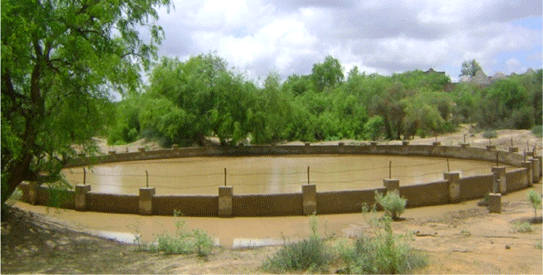
Prior to the rains, the Tharis also clean ditches and depressions locally known as Tal and Tarayoon for storing rainwater.

This water is used both for domestic and drinking purposes.

But, the accumulated rainwater in these ditches and depressions lasts only for three to four months. And for the rest of the eight months of the year, they depend on brackish water of wells, which results in health hazards among humans and livestock.

Often the outbreak of diseases among livestock deepens poverty situation in Thar manifold, as livelihood of the poor 70 per cent depends on livestock rearing.

Mukesh Suther, an Umerkot-based rainwater conservation expert, remarked that “building large ponds and laying a geo-membrane sheet under these (ponds) to stop seepage and covering them with roofs can be of great help in slowing down evaporation of stored rain water during the sizzling summer days.”

He said the government should introduce these low-cost techniques to harvest huge stocks of water, which can help meet needs of the people throughout the year rather than spending millions of rupees on schemes, which have huge recurring costs for maintenances.

Water conservation experts of PCRWR have suggested that piped roof water harvesting, hamlet level chonra pond, hamlet level nadi pond, chalho pond and dug well recharging system could help conserve huge stock of rainwater. But, introduction and promotion of such water conservation techniques was not possible without one time investment by the government.

A senior official in the water section of the Sindh Planning and Development (P&D) Department said: “Although no initiative for rainwater harvesting in Thar has ever been launched by the provincial government, multi-million rupees schemes for tapping rainwater in the desert area are now under consideration of the department`s planners.

There is possibility that such schemes may be included in the next year`s Annual Development Programme (ADP).”

Weblink: http://www.dawn.com/2011/03/07/rainwater-harvesting-in-parched-tharparkar.html