Showing posts with label Agriculture. Show all posts

Monday, March 7, 2011

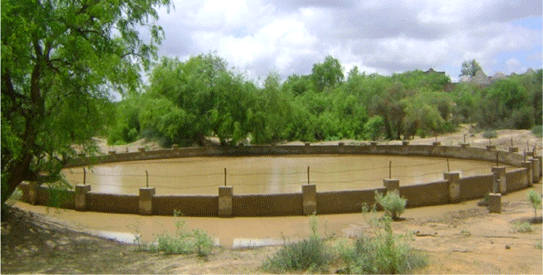
Rainwater harvesting in parched Tharparkar


By Saleem Shaikh


THE Tharparkar district receives on an average 100mm rain every year, which should be sufficient for its drinking and agriculture purposes. But much of it goes waste due to lack of rainwater harvesting and poor water conservation facilities.

During August last year heavy rains in the Thar Desert recharged parched shallow wells, raised water table in deep wells and filled household cisterns. But, after four months, the Tharis were without sufficient water even for drinking, and many had to walk miles to fetch water. Herdsmen had to take their livestock to barrage areas to avoid mortality among them due to water shortage.

“When it rained heavily, it turned our dusty and arid villages in the district into an oasis with lush green foliage and plenty of water to drink and take bath. It also turned our dried-up rangeland into green meadows and pastures for our cattle. But the accumulated rainwater evaporated within a few months and we had to walk for 4-5 miles thrice a week to fetch water from deep wells. Water of such wells is brackish, contaminated and injurious to both humans` and animals` health,” said Ali Akbar Rahimo of the Association for Water, Applied Education and Renewable Energy in Nagarparkar.

Thar normally experiences drought every third year and famine after each decade, triggering mass migration of peasants to irrigated areas in lower and central Sindh in search of fodder, labour and water. A large number of cattle also die during such arduous journeys.

According to a study of the Pakistan Council for Research on Water Resources (PCRWR), the entire Thar Desert receives around one trillion litres of rain annually “ sufficient, if stored, for three years to meet domestic water needs of the Tharis and their livestock. But, more than 95 per cent of it is lost under sand dunes or evaporates in the sizzling summer due to inadequate storage and rainwater harvesting facilities.

“Even if 0.25 per cent of the rainwater is conserved or harvested, it can meet the domestic water needs of the entire human population and livestock of the area,” said water conservation experts of the PCRWR.

The councils` study found out that hardly 0.06 per cent of the overall annual rain water is harvested by Tharis in household cisterns or in other indigenous ways. However, the study suggests that the water shortage problem can be addressed by improving capacity of rainwater harvest by scaling it up from 0.06 per cent to at least 0.25 per cent of the rainfall.

The Tharparkar district, spread over nearly 22,000 square kilometers, is a chronically poor with an estimated population of 1.2-1.3 million. Of them, 95 per cent people live in and around 2,000 villages.

In a normal day, members of each household spends around 4-6 hours in fetching 4-5 pots (50-60 litters) of water from wells However during the dry season they collect water throughout the day including at nights.

However, rains in Thar invigorate socio-economic activities as people start cultivating crops, bringing back their livestock in herds from barrage areas and storing rainwater as much as possible.

Usually Tharis prepare their fields every year much before the rainy season starts by ploughing and broadcasting seeds of millet (bajhri), cluster bean (guar), sesame (tir), kidney bean (mooth), cow peas (Choonra), musk melon (gidro), water melon (hindano), squash melon (meho), wild cucumber (chibbhar), amaranths (mariro), digeria (lular) and other wild plants. The land in Thar is so fertile that once the ploughed fields receive the first shower, they turn green.

Prior to the rains, the Tharis also clean ditches and depressions locally known as Tal and Tarayoon for storing rainwater.

This water is used both for domestic and drinking purposes.

But, the accumulated rainwater in these ditches and depressions lasts only for three to four months. And for the rest of the eight months of the year, they depend on brackish water of wells, which results in health hazards among humans and livestock.

Often the outbreak of diseases among livestock deepens poverty situation in Thar manifold, as livelihood of the poor 70 per cent depends on livestock rearing.

Mukesh Suther, an Umerkot-based rainwater conservation expert, remarked that “building large ponds and laying a geo-membrane sheet under these (ponds) to stop seepage and covering them with roofs can be of great help in slowing down evaporation of stored rain water during the sizzling summer days.”

He said the government should introduce these low-cost techniques to harvest huge stocks of water, which can help meet needs of the people throughout the year rather than spending millions of rupees on schemes, which have huge recurring costs for maintenances.

Water conservation experts of PCRWR have suggested that piped roof water harvesting, hamlet level chonra pond, hamlet level nadi pond, chalho pond and dug well recharging system could help conserve huge stock of rainwater. But, introduction and promotion of such water conservation techniques was not possible without one time investment by the government.

A senior official in the water section of the Sindh Planning and Development (P&D) Department said: “Although no initiative for rainwater harvesting in Thar has ever been launched by the provincial government, multi-million rupees schemes for tapping rainwater in the desert area are now under consideration of the department`s planners.

There is possibility that such schemes may be included in the next year`s Annual Development Programme (ADP).”

Weblink: http://www.dawn.com/2011/03/07/rainwater-harvesting-in-parched-tharparkar.html

Saturday, February 12, 2011

Shortage of agriculture inputs in Sindh


By Saleem Shaikh

Daily Dawn
February 12, 2011

KARACHI, Feb 11: Representatives of farmers of Sindh have complained of shortage of agriculture inputs which has caused an abnormal hike in their prices and black-marketing by unscrupulous traders.

The officials in the provincial agriculture department refute the claims.

According to leaders of farmers’ associations, severe shortage of inputs has affected Rabi sowing. They said if the shortage persisted, it would have serious implications for the Kharif sowing as well.

“Reduced use of the urea fertiliser and DAP by farmers as a result of shortages and escalation in prices during Rabi season will cause decline in per acre yield,” said Dr Nadeem Qamar, president of the Sindh Chamber of Agriculture (SCA).

Sindh Abadgar Board president Abdul Majeed Nizamani said that the urea fertiliser prices had escalated by nearly 23 per cent in the past two months.

The sudden hike in fertiliser prices was bound to lead to decline in production of Rabi crops, particularly wheat, between 20 and 30 per cent of the total production, he said.

“In December last year, a fertiliser bag of 50 kg was selling at Rs850. But, at present it is being sold at Rs1,200 on black. There are also reports of fertiliser being sold at Rs1,250 per bag in some upper Sindh districts. Besides, DAP prices have also increased by Rs150 to Rs200 per 50kg bag in the past two months. At present, a DAP bag is selling at Rs3,200, which sold at Rs3,100 to Rs3,150 in December last year,” he said.Sindh requires around 552,063 tons urea fertiliser and 196,000 tons DAP for Rabi sowing.

According to latest figures of the agriculture department, till Dec 31 last year some 268,845.560 tons of urea fertiliser has been supplied to local traders by some prominent fertiliser manufacturing companies to meet needs of the province’s Rabi crops.

Statistical data about DAP supplies could not be made available by the provincial agriculture department.

Mohammad Arif Khairi, deputy secretary of agriculture, said that supplies of urea fertiliser and DAP for the Rabi crops from manufacturers has remained smooth and there was no disruption from them throughout the Rabi season.

He did not rule out what he described ‘an artificial shortage’ by some profiteers who also manipulate prices in local markets, who sell farm inputs much above the prices set by the government.

Nabi Bux, additional general secretary of the SCA, alleged the dealers and fertiliser manufacturers took benefit of the prevailing situation of the fertiliser and DAP and earned millions of rupees in profit in a matter of a few months by creating the artificial shortage.

Weblink: http://www.dawn.com/2011/02/12/shortage-of-agriculture-inputs-in-sindh.html

Wednesday, February 2, 2011

Canals` Closure Creates Water Scarcity in Sindh


By Saleem Shaikh

Daily Dawn

January 31, 2011

saleemzeal@gmail.com

THE scarcity of both irrigation and drinking water in many parts of Sindh has sparked protests and rallies by farmers, traders and the people whose day-to-day socio-economic lives and standing crops have been affected.

The water shortage has aggravated following closure of canals during the second week of December for de-silting and repair/maintenance work at barrages, canal heads, and regulators.

On November 23, the federal ministry for water and power had announced canal closure schedule for de-silting and repair from December 26, 2010 to January 31, 2011. The provincial irrigation department and relevant authorities were directed to strictly adhere to the schedule and make alternative arrangements for providing water for irrigation and drinking in their respective provinces.

But, alternative arrangements were not adequate in many areas of Jacobabad, Sukkur, Qambar-Shahdadkot, Hyderabad, Tando Allahyar, Tando Adam, Matiyari, Sanghar, Thatta, Badin and Umerkot districts. In these shortage-hit districts, the underground water has also turned brackish because of closure of the canals.

The Sukkur Barrage and its seven off-taking canals were shut in the first week of January for annual repair and maintenance. But, because of lack of coordination between the office of the barrage`s chief engineer and municipal administration, the city and its adjoining areas suffered acute water shortage.

In anticipation of shortage in the Sukkur region, the provincial government assigned the North Sindh Urban Services Corporation (NSUSC) to arrange supply of water to people of Sukkur, Rohri and adjoining areas through tube-wells in a week`s time.

The NSUSC is a public limited company working under the local government. But, a dispute broke out on January 5 over drilling of wells for alternative supply of drinking water when irrigation officials forcibly got the corporation`s drilling work halted and the machinery removed from the sites.

When NSUSC`s Sukkur director Abid Hussain asked as to why they had stopped their work, the irrigation officials told him to approach the Executive Engineer Sukkur Barrage Zareef Khero on this issue.

“But, Zareef Khero when contacted said he had no concern with it,” a NSUSC official said. Meanwhile, this scribe also tried to approach the relevant district government officials to find out their version, but they refused to comment.

A Sukkur town municipal official told this scribe that “against the daily requirement of 16 million gallons of water, the city is getting only nine million gallons.”

The residents complain that much of it is contaminated as it is supplied through leaked and damaged supply lines, which run parallel to the drainage pipelines.

People of different localities fetch expensive water from hand pumps installed in the low-lying areas of the city.

NSUSC Sukkur Assistant Director Manzoor Ahmed Bachkani said the situation was slowly improving in some parts of the city. “Now the closure of Sukkur Barrage is over and enough water is being supplied to the affected residents,” he remarked.

On December 20 last year, Chief Engineer Irrigation of the Kotri Barrage had notified for the information of landholders, cultivators, Hyderabad`s Water and Sanitation Authority (Wasa), civic agencies of adjoining districts and all concerned that the barrage canals would remain closed from December 25 to January 01 for normal inspection, maintenance and necessary repairs. During this period there would be no water flowing in any of the barrage`s off-taking canals namely Akram Wah (Lined Channel) Old Phuleli (Pinyari), New Phuleli (Phuleli), Kalri Baghar Feeder Upper, Wadhu Wah and Fasadi Wah.

But, the Hyderabad`s Water and Sanitation Agency and district government officials and the TMOs of Thatta, Badin and other districts failed to make arrangements for alternate supply.

The people of Hyderabad, Tando Mohammad Khan, Tando Allahyar, Matiari, Thatta and Badin districts have held officials of Taluka municipal administrations responsible for their water woes.

According to reports, more than 800,000 people are facing water shortage in the said districts.

Badin, a town of more than 200,000 people, is the worst hit in lower Sindh, facing water shortage for more than 45 days. Standing vegetable and Rabi crops in and around the area are also at the risk of being damaged.

Lar Abadgar Board`s Amin Memon said: “The locals never opposed de-silting and maintenance work at the Qazia Canal, which is the chief source of drinking water for the people of Badin city and its adjoining areas. But alterative arrangements for water supply should have been made by the TMA.”

Water scarcity had equally affected the people and farmers as seedlings of tomato and other vegetables were drying up due to zero availability of water in canals and distributaries. Besides, fish farmers have also suffered massive losses because of short supply of fresh water,” he pointed out.

Meanwhile, senior officials at the Kotri Barrage told this scribe on phone that water shortage situation downstream Kotri Barrage districts was unlikely to improve before mid-February as the repair/maintenance work would take another two or three weeks.

Weblink:

http://www.dawn.com/2011/01/31/canals-closure-creates-water-scarcity-in-sindh.html

Monday, January 24, 2011

Rise in urea price frustrates Rabi Growers in Sindh


By Saleem Shaikh
January 6, 2011
Recent 23 per cent rise in prices of urea fertiliser, an important farm input and cause of good farm yield, its black marketing and hoarding hoarding have frustrated the Rabi growers, who are struggling to help flood-hit agriculture sector recover. The farmers have called for withdrawal of the undue increase in urea prices; otherwise, it would affect the farm production adversely.

The farmers’ leaders blame agriculture and district government officials are working hands in gloves with those traders involved in hoarding, black marketing of the urea and phosphate fertilisers.

Unavailability of the urea to the farmers in time and at the appropriate prices would only hurt yields of the Rabi crops and intensify food insecurity further in the province.

“The issue of rising urea prices, its black marketing and hoarding has been raised with the local agriculture officials and those sitting on the government benches in the Sindh Assembly. But, our complaints have gone unheeded and unaddressed,” said Akhund Ghulam Mohammad, general secretary of the Sindh Chamber of Agriculture (SCA).

The growers would be compelled to reduce use of urea in their fields, if recent rise was not withdrawn, he said.

Random conversations with growers point to the fact that they have significantly reduced application of fertilisers because their prices have been steadily spiraling, which has emerged to be, among others, a main cause of falling levels of yields of Rabi and Kharif crops.

Till October 30, the urea (Sona FFC brand) was selling between Rs850-Rs853 per bag of 50 kilogramme while another prominent urea brand (Urea Kissan of NFC) was at around Rs830 per bag of the same quantity across the province.

But, the manufacturers increased the urea prices to Rs1,040/per bag. But, traders in different parts of the province have further increased the urea price on their own and are selling between Rs1100-Rs1200.

So much so, the fertiliser traders have also induldged in artificial shortage of the key farm inputs at the time when the fields, on which the Rabi crops are being sown, direly need them (farm inputs).

Reports have also poured in that the fertiliser dealers are not keeping urea stocks in their godowns and instead allegedly hiding it elsewhere to earn huge profits.

“Despite provincial agriculture department’s clear instructions, the dealers have failed to maintain stocks of urea in their godowns and every time we visit their storage houses they tell us that they are out of stocks,” Said Nabi Khan Brohi, leader of Sindh Abadgar Board in Shahdadkot.

They growers have also slammed the district administrations, where black marketing and hoarding have become rampant despite escalation in its prices.

It is matter of disappointment that the role of agriculture deparment and DCOs is equal to nothing and they hardly visit the markets to contain the artificial shortage of the fertilisers and escalation in their prices. This has situation has rather encouraged the unscrupulous traders to exploite hapeless farmers, said disgruntled growers.

“We have brought the matter into notice of the district administrations and agriculture department officials to crack down on the hoarders, profiteers and unscrupulous traders, who are involved in unlawful price hike of the urea. But, the officials are reluctant to take action against them,” said Meher Ali Tunio, a prominent wheat grower in Larkana.

When contacted, some district coordination officers voiced their ignorance about the black marketing, hoarding and rise in their prices and refused to comment on the matter other than saying that they were trying to resolve the problems of the farmers.

Nevertheless, other district government officials of Shikarpur, Shahdadkot and Larkana districts said that if such was the situation then they would definitely bring such unscrupulous traders to book.

Meanwhile, the Sindh Abadgar Board has warned the Sindh government and the fertiliser manufacturers that it would move the Sindh High Court against them, if the unjust and arbitrary rise in urea prices was not withdrawn and its artificial shortage not brought to an end.


Abdul Majeed Nizamni, president Sindh Abadgar Board, said that recent hike in urea prices would force growers to cut the use of the urea, which could cause decline of some 2.72 million tons in overall production of Rabi crops.

“If the urea prices are not brought down to Rs850/ bag, then it would increase the food export bill to $6 billion for the FY 2010-11,” he forewarned.

The total food import bill has touched $2.15 billion in July-Nov, 2010 as compared to $1.3 billion in the same period of 2009.

Member of SCA, Anwar Bachani, said that the chamber had already informed the federal government about the unjust hike in the urea price but it discovered that it had no idea about the gravity of the situation and the prices have been hiked without seeking permission of the federal Minister of Food, Agriculture and Livestock (Minfal).

Growers’ leaders believe that that repeated hikes in prices of fertilisers by the manufacturers without informing the relevant government departments was all happening due to absence of an effective regulatory body.

An official in the provincial agriculture department admits that some weeks back the fertiliser manufacturers had informed the federal government that there would be urea shortage of 250,000 tons and suggested its import to avoid the shortage or upsurge in prices.

“But, the Minfal ministry was hardly moved by the intimation and did not responded to the fast unfolding situation of urea shortage, which has led to the escalation of its prices,” said a senior official in the Sindh agriculture deparment, who preferred anonymity.

However, the farmers’ representatives have warned of steep fall in Rabi output, if the urea and phosphate was not available to the farmers in required quantity at the pre-November 2010 rates.

Sindh agriculture struggling for recovery

By Saleem Shaikh
January 3, 2011
THE coming Rabi crops are likely to show good performance if water availability is improved and provision is made for distribution of high-yield seeds, unadulterated fertilisers and unhindered agriculture credit.
Agriculture experts believe that timely recovery of the agriculture sector in the province depends on early draining out of floodwater from inundated farmlands, rehabilitation of damaged irrigation network and roads and provision of unhampered financial support and free farm inputs.
Although Sindh Minister for Irrigation Jam Saifullah Dharejo claimed that the flood-hit irrigation network would be restored by end of December, the situation remained unpromising as most of the breaches have not been repaired as yet.
Sindh irrigation department officials admit that rehabilitation of irrigation networks is very slow. “Though 80 percent floodwater has been flushed out of the flood-ravaged areas, only 660 out of some 2,138 breaches have been plugged so far and floodwater is still flowing through 1,478 breaches,” a senior irrigation official said quoting a report. But, Mehfooz Ursani, general secretary of the Sindh Abadgar Board (SAB), rejected official claims that 80 per cent floodwater had been drained out. He said that despite passage of four months since the flood hit Sindh, much of the affected areas still remains inundated seriously affecting Rabi sowing.
Sindh government has announced support packages and low mark-up loans for flood-hit farmers and drawn out plans to rehabilitate the damaged irrigation network to restore agro-based activity. But, progress is very slow, he said.
Tight financial situation of the provincial government is also hindering the launching of support packages for farmers and expediting process of plugging irrigation network breaches.
Sindh Agriculture Secretary Agha Jan Akhtar hopes that wheat sowing target will be achieved, because major wheat growing areas on the left bank of the Indus River remained unaffected during the floods.
“Efforts are being made to encourage the left bank growers to grow more wheat. Initiatives have already been taken to resolve the cane price issue between the growers and the millers,” he remarked.
The agriculture secretary said that minor crops sowing was also in full swing in the lowing-lying areas on the right side of Indus River, from where water has been pumped out and hopes for good sowing of minor crops particularly pulses and vegetables and fodder were bright.
Amin Thebo, director crop reporting, said that sowing of vegetables, have recently picked up pace in left bank areas that were under cane crop.
“Reports of wheat sowing and vegetable cultivation have poured in recently from the scattered cane growing areas in the right bank areas, where fields have been cleared of cane,” he remarked.
While the floodwater is likely to be flushed out completely by March 2011, improving Kharif sowing.
Sindh’s agriculture has suffered enormous damages in recent floods and rains but no significant measures have been taken so far for its recovery.
Overall damage suffered by agriculture has been estimated at 2.3 billion dollars, according to provincial government’s revised figures. “The province’s paddy crop sown on around 0.7-0.8 million acres was washed away, causing losses to the tune of Rs60 billion,” said a provincial agriculture department official.
Sindh agriculture department officials estimate production of around 663,000 tons of rice in the province against the target of 2.039 million tons for Kharif 2010. The shortfall of 60 per cent is because of the fact that rice on around 850,000 acres, against the target of 1.586 million acres, had been washed away by floods.
The cotton crop, sown on either side of the Indus River, was also hit by the flood on the right bank.
Agriculture department officials said the province, which achieved a record production last year, has experienced short crop this year by around 13.63 per cent to 3.321 million bales recorded till December 15, 2010 as compared to 3.845 million bales in the corresponding period of last year.
As far as sugarcane is concerned, it was cultivated on much less area in the province due to water scarcity. Unattractive support price, ill-and exploitative attitude of sugar millers and lack of government interest has compelled the growers to cut the area under cane cultivation.
Despite water shortages, rains and unfavorable climatic conditions during FY10, the province’s agriculture sector is expected to show a reasonable performance. Contrary to expectations. The performance of minor crops is to remain more or less satisfactory due to switch over of area from major (for example: sugarcane) to minor crops.
THE coming Rabi crops are likely to show improved performance only if water availability is improved and provision are made for high-yield seeds, unadulterated fertilisers and unhindered agriculture credit loans.
Agriculture experts say that timely recovery of the agriculture sector and its bright outlook depends on early draining out of floodwater from inundated farmlands, rehabilitation of damaged irrigation network and roads and provision of unhampered financial support and free farm inputs.
Although Sindh Minister for Irrigation Jam Saifullah Dharejo claimed tat the flood-hit irrigation network would be restored by end of December, the situation remains unpromising For, most of the breaches have not been repaired as yet.
Officials in the provincial irrigation department admit that rehabilitation of irrigation networks is very slow. “Though 80 percent floodwater has been flushed out of the flood-ravaged areas, only 660 out of some 2,138 breaches have been plugged so far and floodwater is still flowing through 1,478 breaches,” a senior irrigation official said quoting a report.
But, Mehfooz Ursani, general secretary of the Sindh Abadgar Board (SAB), rejected official claims that 80 per cent floodwater had been flushed out.
He said that despite passage of four months since the flood hit Sindh, much of the affected areas still remain inundated. Therefore, Rabi sowing would suffer seriously.
The provincial government has announced support packages and low mark-up loans for flood-hit farmers and drawn out plans to rehabilitate the damaged irrigation network to restore agro-based activity. But, progress is very slow, he said.
Tight financial situation of the Sindh government is also hindering the launching of support packages for farmers and expediting process of plugging the breaches in the irrigation network.
Sindh Agriculture Secretary Agha Jan Akhtar hopes that wheat sowing target will be achieved, because major wheat growing areas on the left bank of the Indus River remained unharmed during the floods.
“Efforts are being made to encourage the left bank growers to grow more wheat. Initiatives have already been taken to resolve the cane price issue between the growers and the millers,” he remarked.
The agriculture secretary said that minor crops sowing was also in full swing in the lowing-lying areas on the right side of Indus River, from where water has been pumped out and hopes for good sowing of minor crops particularly pulses and vegetables and fodder were bright.
Amin Thebo, director crop reporting, said that sowing of major Rabi crops, particularly vegetables, have recently picked up pace in left bank areas that were under cane crop.
“Reports of wheat sowing and vegetable cultivation of Rabi season have poured in recently from the scattered cane growing areas in the right bank areas, where fields have been cleared of cane,” he remarked.
Agriculture experts said that although 80 per cent of low-lying areas on the right bank are being claimed to have been brought under Rabi crops while the floodwater is unlikely to be flushed out completely before March 2011. Nevertheless, chances are bright for Kharif sowing of FY 2011.