Showing posts with label Pakistan. Show all posts

Thursday, February 24, 2011

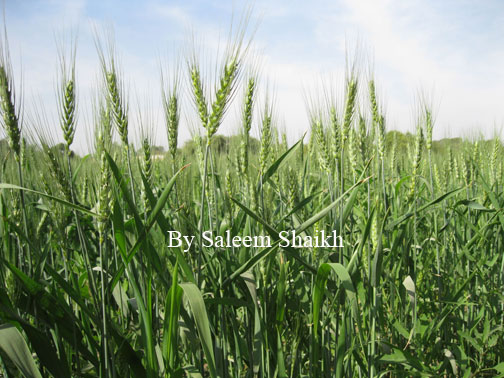
Bumper wheat crop likely in Sindh


By Saleem Shaikh

February 21, 2011

HEAT sowing in Sindh has surpassed the target, and chances for bumper production are bright provided the standing crop receives final doses of water and urea preferably before the end of February.

Wheat harvest usually begins from mid-March in lower Sindh, and is in full swing in April in upper Sindh districts.

In October, the Federal Committee on Agriculture had set production and sowing targets for Sindh at 3.682 million tons and 10,31,000 hectares respectively for the ongoing Rabi season.

Sindh Agriculture Department officials claim that wheat sowing in the province has crossed the target. “Till February 10, the crop had been planted on around 10,81,000 hectares, while cultivation will continue till mid-March, easily touching 11,00,000 hectares,” said Ashfaq Ahmed Soomro, additional secretary, Sindh Agriculture Department.

Officials say that owing to vigorous wheat cultivation activities in districts on the right bank of Indus River, wheat production target would be easily achievable. “We are expecting some 3.8 million tons of crop against 3.682 million tons for the current Rabi season,” they said.

For the ongoing Rabi season, per acre yield target was set at 36.1 maunds. But, Bashir Thebo, Director Statistics wing, Department of Agriculture, said average per acre yield was expected between 40-50 maunds; An average of 60 maunds in some areas, where quality of land was better, and farm inputs were timely available, was also being expected.

“Favourable climatic conditions, availability of quality seeds and fertilisers and luckily no viral attacks are other major positive factors behind vigorous sowing and higher acreage.”

There are also other factors behind the robust sowing such as: “Plans drawn up carefully for achieving the target were implemented in time. All farm inputs and other facilities were made available to growers at market price in proper manner to facilitate cultivation in maximum area,” said Asfaq Ahmed Soomro, additional secretary of the department.

Additional general secretary of the Sindh Chamber of Agriculture (SCA) Muhammad Hussain Khushik warns that the crop may post a decline of 25 per cent if the crop fails to get essential last doses of water and urea in time.

“The recent 23-25 per cent increase in prices of urea and DAP, may leave no option for the growers – particularly small farmers – but to avoid the essential doses,” he feared.

According to the Federal Bureau of Statistics (FBS), in December a urea fertiliser bag of 50kg was selling at Rs850 in most of the wheat growing districts of the province.

But, at present it is being sold at Rs1,200 per bag and reportedly at Rs1,250 per bag in some upper Sindh districts. Besides, DAP prices have also gone up by Rs150-200 per 50kg bag in the past two months. At present, a DAP bag is selling at Rs3,200, the FBS reports says.

Weblink: http://www.dawn.com/2011/02/21/bumper-wheat-crop-likely-in-sindh-2.html

Thursday, February 10, 2011

Undernourished labour with low productivity


February 7, 2011

AN under-nourished worker is unable to maximise production. The nutrition level, if improved as required, can add 2-3 per cent to the GDP growth. Experts attribute low productivity in agriculture to malnutrition of farm labour.

The appalling state of malnutrition in the countryside of the resource-rich and fertile Sindh is the result of grinding poverty and low productivity in all economic activities.

Many complain that while tons of grains and other farm produces go waste due to official negligence and mismanagement, millions in the province have to sleep without enough food.

Officials in the provincial food, agriculture, rural development and planning and development departments argue that many plans have been put in place to fight the underlying causes of poverty, create employment opportunities and boost people`s income.

But those, who critically look at such government`s initiatives, say the situation on the ground refuses to improve รข€“ perhaps because of official inefficiency, corruption and under-utilisation of development budgets and absence of effective monitoring and evaluation of such uplift plans.

Senior economic planning officials in the provincial planning and development department (P&DD) opine that factors such as mal-distribution of income, transfer of resources from the agriculture to urban areas and unemployment, are some of the causes of low-intake of nutrition by the impoverished people.

Poor households across the province spend around 75 per cent of their income on food and healthcare. A study found that 36.3 per cent of the people surveyed in Sindh consumed less than 1,700 calories a day and another 25 per cent consumed between 1,700 to 2,100 calories per day.

According to the Pakistan Demographic and Health Survey 2006-7, a vast majority of rural households are more than 10 kilometres away from basic services that include district administration headquarters, ambulances and maternal and child healthcare centres and hospitals.

Rural populations` access to drinking water through a range of methods such as tube-wells, boreholes or hand pumps account for more than half of such sources. But only 2.8 per cent of rural households in the province use an appropriate water treatment method, such as boiling or filtering.

An independent development economist, Dr Javed A. Ansari, said poverty and rural-urban disparities in the province continue to spiral up because of bad governance, rampant corruption, inadequate budgetary allocations and their misappropriation or poor utilisation.

He, however, believed that the soaring poverty, which had intensified malnutrition, was unlikely to improve until there was increased investment on health, education and basic infrastructure.

“Besides, there is a strong need to finally put nutrition at the centre of development so that a wide range of economic and social improvements that rely on nutrition, can be realised,” said a senior rural development planner in the provincial rural development department.

The province`s fertile farmlands yield surplus grains and vegetables, but these remain unaffordable for millions of people on account of soaring prices and falling incomes.

Escalating food prices have forced financially-battered families to divert funds utilised for education and healthcare of their children to kitchen bduget,” remarked Dr Fawad Ali of the P&D department`s health section.

Pakistan People`s Party MNA Nawab Yousuf Talpur claims that he has often drawn government`s attention towards people`s social and economic hardships, without no positive outcomes as yet.

“I`ve raised issue of massive grain losses and worrisome state of education, health and ruptured basic infrastructure on the floor of the Parliament. I have asked the public representatives, on a point of order, whether they are destined to ruin fertile and resource-rich Sindh, which contributes more than 70 per cent of the country`s total revenue, accounts for some 65 per cent of oil and more than 70 per cent of gas,” he said.

He recalled that he had also highlighted issue of non-availability of quality storage facilities for farm produces during the last budget speech of the federal finance minister.”

Officials in the provincial food department said: “There are some nefarious elements in the government who foil efforts for building modern silos because they get heavy kickbacks and bribes when renting spaces for storing grains.”

Dr Khalid Pervez, who is providing healthcare services at a health facility in Al Jamkanda village of Karachi`s Bin Qasim town, believes that adequate spending on health, education and rural development could turn around the situation of poverty and malnutrition in the province. But, unfortunately such social spending gap had translated into the grinding malnutrition, rise in health diseases, illiteracy, unemployment, poverty and unsafe water and sanitation.

Sadiqa Sallahuddin, a prominent rural and health development expert of the Indus Resource Centre, believes that remedy to malnutrition in the province lies in increased spending for alleviating, what she described, `wild poverty`.

She remarked: “Despite so many socio-economic uplift initiatives and whatever health budget allocation and spending, Sindh remains the most backward in all walks of life. It is because there are some pro-active forces having mala fide interests, who want to keep the province trapped in a socio-economic mess. However, nefarious designs of such unscrupulous forces are only aimed at watering down/bog down endeavours of progressive forces, because, they are those who want to see the province driven on the path of socio-economic development.”

Landlords, so-called public representatives sitting on treasury and opposition benches, corrupt bureaucrats, mafias, among others, were, among the tough challenges to the province`s overall development. These forces hamper every initiative taken for uplift of education, health and political empowerment of the masses, she believed.

Weblink: http://www.dawn.com/2011/02/07/undernourished-labour-with-low-productivity.html
Monday, January 24, 2011

Fall in onion price


By Saleem Shaikh

January 17, 2011

ALTHOUGH onion exporters, traders and growers have been hit by partial ban on export to India, consumers have heaved a sigh of relief after significant decline in the retail prices of the commodity across Sindh.On January 4, the government banned export of onion to India via land route but, yieldeding to exporters’ pressure on January 12, allowed them to honour their contracts reached before the ban and send their consignments to India through Wagah.
While traders wanted withdrawal of the ban, officials in the federal commerce ministry saw dim chances of any such thing to happen.
Officials argue that the country was hit by low onion output and the new crop was not expected in local markets from Punjab before March. Export at this pointof time would escalate onion price in the market.
“The ban has been imposed in view of the possible onion shortage in local markets because of low output in Sindh and Balochistan as tens of thousands of acres under onion crop was washed away by floods,” remarked a Minfal official.
According to market reports, on January 4 some 300 truckloads of onion were stopped at the Wagah border from entering India.
Saud Khan said 300 trucks, stuck up at Wagah border, were each loaded with some 300 maunds of onion. The exporters estimate that the value of their held uponion at the Wagah border is at around Rs140-150 million. The vegetable exporters who procured the onion at around Rs2,100-2,200 per maund from thegrowers would have suffered hefty financial losses, if their consignments of surplus onion were not allowed to enter India, he remarked.
However, the relaxation was only for the orders for which the letters of intents were issued and exporters had received money from India.
“The impact of the ban has already been felt in Nasarpur, the country’s largest onion producing area. The onion prices have sharply declined by about Rs800 per 40kg in the Nasarpur wholesale market. Prior to the ban, the commodity was trading at Rs2,200 per maund,” said Nabi Bakhsh, an onion trader in Matyari district.
The exporters also maintain that there was an abundant quantity of onion in excess of the domestic market demand which they wanted to export.
But Abdul Waheed Ahmad, former president of the All Pakistan Fruit and Vegetable Exporters, Importers and Merchant Association, has highlighted another side of the story. He said that the quality issue is also the cause, which prompted the ban.
“There are reports that the growers harvested pre-mature onion crop for sale to exporters, which is destined to rot and be rejected by the Indian traders once it reached across the border market,” he remarked.
Waheed told this scribe on phone that the onion export was continuing through the sea and air routes to India and export target of 600,000 tons would be easily achieved.
Meanwhile, the ban on onion export has brought down the prices of the commodity which had peaked in December last year because of low crop output in the provinces.
Onion which was selling above Rs70-80 per kg in September last year, was now selling at Rs20-25 per kg in retail markets.
The retail and wholesale vegetable traders say the prices are likely to fall further to as low as Rs15 per kg when new onion crop will arrive from Punjab in March.
High prices of onion during November-December last year led to reduced consumption, and its sale declined significantly in the domestic market, recalled Ali Ahmad Shah, a vegetable trader at the Sabzi Mandi in Karachi. “But now its sale has improved and is increasing day by day, thanks to a significant fall in prices following the ban,” he noted.


Monday, December 27, 2010

Financing Rabi Sowing

By Saleem Shaikh

Monday, 18 Oct, 2010 | 01:14 AM PST |

THE Sindh government’s efforts to boost Rabi cultivation may receive a setback if banks do not fully cater to the credit needs of the flood-ravaged growers.

Farmers complain that banks are risk-averse facing financial squeeze, particularly due to the recent sharp increase in their non-performing loans in agriculture sector, which has been devastated by the floods.

While significant amount of standing Kharif crops, farming machines, seed stocks for Rabi crops and fertilisers have been washed away, the farmers are less likely to be able to undertake Rabi sowing on their own. And, therefore, “financial assistance for the flood-hit farmers is a must,” the agriculture economists believe.

Displaced by the ravaging floods, the financially-battered farmers are willing to go back to their fields and get engaged in Rabi sowing. But, they need seed, fertiliser, DAP, pesticides and farming tools for ploughing and land leveling, for which they should have an easy access to financial support.

Reports that growers are facing obstacles in obtaining credit loans from banks in flood-ravaged districts of the province have surfaced recently. Farmer leaders say, “when they visit banks for farm credit they are discouraged in different ways.”

“Bank officials tell farmers that they have been directed not to sanction any credit without valid guarantees,” said a farmer. “Other than government, who else can provide guarantees to such hapless farmers who have lost everything and are now penniless,” he questions.

“In this hour of need these farmers are looking towards the government to rescue them from the misery with financial support for raising their crops,” said Akhund Ghulam Mohammad, general secretary of the Sindh Chamber of Agriculture.

On September 24, following deliberation on reviving flood-hit agriculture in Sindh between the provincial government and the State Bank governor, banks were approached to provide agriculture loans to flood-hit farmers. But the banks, in a reply to the provincial planning and development department’s request, questioned the government’s proposal and said it did not meet (banks’) certain criteria for sanctioning loans.

“They ask for surety measures,” said an official in the economic planning section of the provincial P&DD.

Another official in the provincial finance department said that the provincial government had brought the matter of banks’ reluctance to farm credit to the notice of the SBP and asked it to help sort out the matter.

Meanwhile, the provincial government has also tried to know banks’ viewpoint through the SBP if they would provide loans to farmers against ‘Form VII’ (ownership deed) and possession certificates supported with guarantees and undertakings from the provincial revenue department; and that the farmers’ passbooks would be issued to them within specified time, a senior official in the provincial revenue department said.

But the banks, an official told this scribe, have declined to accept such proposals. Instead, they have demanded record of average sales value over three years, number of produce index units (PIUs) and credit history of borrowers, which would help the lending banks to evaluate value of farm land to be offered as collateral.

An official in a bank’s main branch in Karachi said the banks had refused to accept the ownership deed on the ground that it was not possible to verify it as the revenue record of the flood-hit farmers might have been destroyed.

He said that banks feared default on such risk-prone farm loans and subsequent litigations against the defaulting farmers. The proposed undertaking by the provincial Board of Revenue (BoR) would not have any legal validity in establishing their claim over a property in a court of law.

In the first week of October, an official in the central bank’s farm credit department conveyed to provincial P&DD secretary Naheed Durrani that the banks would sanction loans to farmers only if the government furnished a ‘provisional credit surety’ to banks up to the loan amount in conjunction with the markup till the time the charge was created on the passbook in favour of the banks in conformity with the Commercial and Industrial Purposes Act 1973.

One of the major reasons behind the banks’ evident wariness towards loaning the farming sector is that recent floods have raised the NPLs, said a senior bank official.

The central bank estimates these NPLs to be over Rs28 billion, according to the preliminary data of the SBP.

The bankers say that the flood-hit agriculture sector is in the worst shape, which needs a hefty amount for revival. “Not only have the infrastructure but also the land been ravaged by the deluge. It means preparation of the land for cultivation would be a difficult task and will not be possible without huge financial investments. However, it is not going to happen until the government ensures its increased and active participation,” they opined.

Officials in the provincial agriculture department state: “We have chalked out a plan for the revival of farmlands in the province from where over 60-65 farmers took refugee after the deluge battered their crops and villages. But, the ‘agriculture revival plan’ will be of no use if the farmers fail to get hassle-free access to farm credit on low markup.”

Available on Dawn Newspaper's website:

http://www.dawn.com/wps/wcm/connect/dawn-content-library/dawn/in-paper-magazine/economic-and-business/financing-rabi-sowing-800